SEO vs GEO Marketing: How Brands Can Win in Google and AI Search
ShareSaathi Intelligence
Head of Research
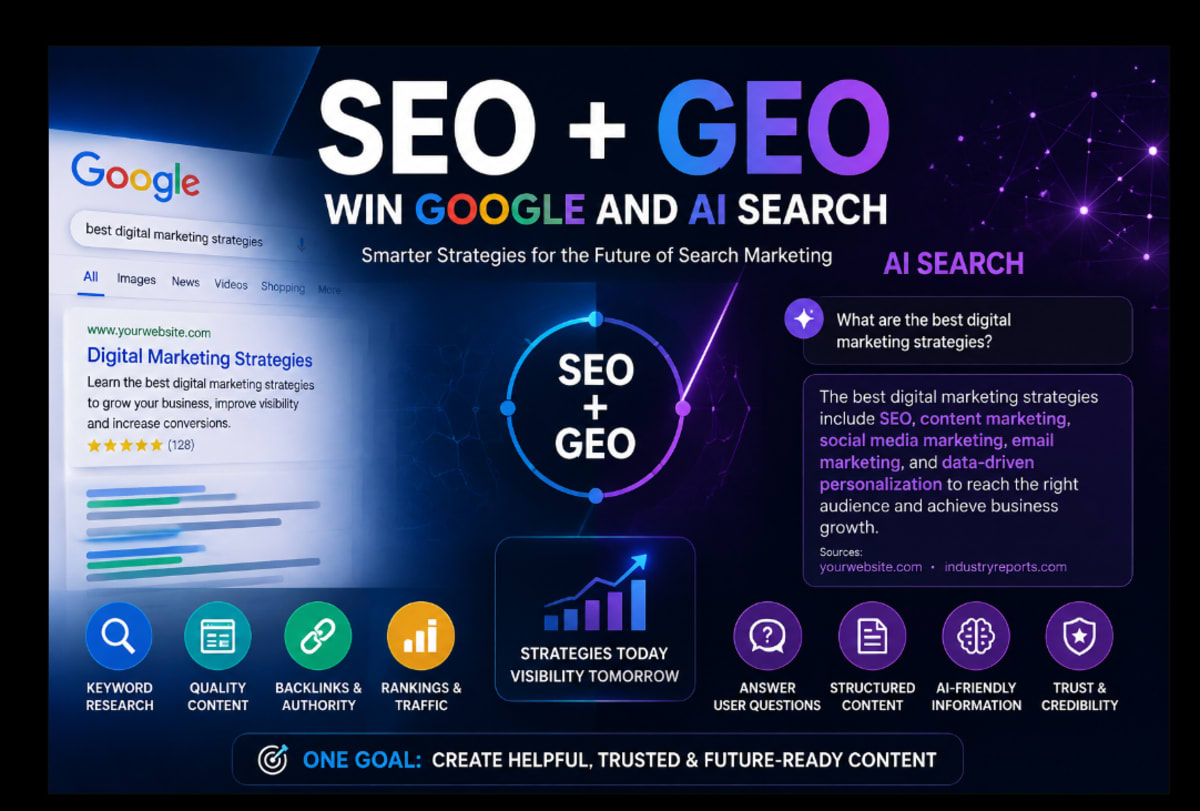
Search is no longer limited to traditional search engines. Users are increasingly turning to AI-powered platforms to ask questions, compare products, research companies and find answers. This shift is changing how businesses and publishers approach digital marketing.
For years, Search Engine Optimization (SEO) has been the foundation of online visibility. Today, a complementary approach known as Generative Engine Optimization (GEO) is gaining importance as businesses look to improve their visibility in AI-generated answers.
The future of search marketing is therefore not simply about ranking higher on Google. It is about creating content that is discoverable by search engines, useful to readers and understandable to AI systems.
What Is SEO?
Search Engine Optimization is the process of improving a website and its content so that search engines can better understand, rank and display it for relevant queries.
Traditional SEO focuses on several areas, including:
Keyword research Search intent High-quality content Internal linking Backlinks Website structure Page speed Mobile experience Metadata Technical SEO
For example, a financial website publishing an article about an IPO may target keywords such as “Garuda Aerospace IPO,” “Garuda Aerospace IPO date” and “Garuda Aerospace IPO size.”
However, simply inserting these keywords repeatedly is no longer an effective content strategy. The article needs to genuinely answer the questions users are asking.
What Is GEO Marketing?
Generative Engine Optimization (GEO) is an emerging approach focused on improving the likelihood that content will be understood, surfaced or referenced by AI-powered search and answer systems.
Instead of focusing only on:
“How do we rank this webpage?”
GEO encourages publishers to also consider:
“How can we provide the clearest and most useful answer to the user's question?”
This means content should be structured around clear questions, direct answers, factual information, context, reliable sources and original insights.
GEO should not be viewed as a replacement for SEO. Instead, businesses can use both strategies together.
SEO vs GEO: What's the Difference? SEO GEO Focuses on search engine visibility Focuses on AI-powered search visibility Targets keywords and search intent Targets questions, entities and information needs Optimizes webpages Optimizes information for AI understanding Focuses heavily on rankings and clicks Focuses on visibility within generated answers Uses internal links and backlinks Benefits from clear facts, context and authoritative sources Optimizes for search engines and users Optimizes content for users and generative systems
The two approaches overlap significantly. High-quality, authoritative content remains important for both.
- Start With Search Intent, Not Just Keywords
One of the biggest mistakes in content marketing is creating an article around a keyword without understanding why someone is searching for it.
For example, someone searching “Garuda Aerospace IPO” could be looking for:
IPO approval IPO date Issue size Valuation Financial performance Business model IPO risks Listing information
Instead of producing a short article that repeats the keyword, publishers can address these related questions within a well-structured piece of content.
This creates a better experience for the reader while covering multiple search intents.
- Use Question-Based Content
People increasingly search using complete questions.
Instead of targeting only:
Garuda Aerospace IPO
content can target questions such as:
What is the Garuda Aerospace IPO? When could the Garuda Aerospace IPO open? What is the expected issue size? What does Garuda Aerospace do? Is Garuda Aerospace profitable? What are the risks associated with the company?
Question-based content can help publishers capture long-tail searches and provide information in a format that is easy to understand.
- Add a Quick Answer at the Beginning
Readers should not have to read 1,000 words before finding the main answer.
A useful approach is to add a short summary immediately after the introduction.
For example:
Quick Answer: Garuda Aerospace is preparing for a potential public listing after receiving regulatory approval for its proposed IPO. Investors will need to watch the final issue structure, price band, valuation and IPO timeline.
This gives readers immediate context while the rest of the article provides deeper analysis.
- Build Strong Topic Clusters
Publishing individual articles is not enough to build long-term authority.
Instead, websites should create topic clusters.
For example, a website covering IPOs could build a complete cluster around one company:
Main Topic
Garuda Aerospace IPO
Supporting Topics Garuda Aerospace IPO date Garuda Aerospace IPO valuation Garuda Aerospace financials Garuda Aerospace business model Garuda Aerospace competitors Garuda Aerospace IPO GMP Indian drone industry Drone stocks in India
These articles can be connected through strategic internal links.
This helps users discover related information while giving search engines a clearer understanding of the website's coverage of the subject.
- Make Internal Linking More Strategic
Internal linking is an important SEO technique, but the links should provide genuine value.
Instead of:
Click here to read more
use descriptive anchor text such as:
Read our guide to upcoming IPOs in India.
This gives users and search engines context about the destination page.
For financial websites, internal links can connect IPO news with company profiles, market explainers, stock research and related industry articles.
- Create Content With Clear Entities and Relationships
AI systems need to understand who, what, where and how different concepts are connected.
Consider an article about Garuda Aerospace.
Instead of mentioning the company name repeatedly, clearly establish the context:
Garuda Aerospace → Indian drone technology company → Chennai → agriculture and defence applications → proposed IPO → SEBI regulatory process
This creates a clearer information structure.
The same approach can be used for companies, products, people, industries and financial events.
- Use Original Data and Analysis
One of the biggest opportunities for publishers is original analysis.
Simply rewriting information from another news website provides limited additional value.
Instead, add:
Financial comparisons Industry comparisons Competitor analysis Valuation analysis Historical performance Market trends Business-model analysis Risks and opportunities
For example, an IPO article could compare the company's revenue, profitability and valuation with other listed companies in the same sector.
This creates content that is more useful than a basic news rewrite.
- Make Financial Content Highly Factual
Financial content requires particular attention to accuracy.
Avoid unsupported statements such as:
“The company is expected to become a market leader.”
Instead, provide measurable information and identify the source where appropriate.
For example:
“The company reported operating revenue of approximately ₹118 crore in FY25, according to reported company filings.”
Specific facts provide greater context and make the content more useful to readers.
- Add FAQs to Important Articles
A well-designed FAQ section can address questions that readers commonly have.
For an IPO article, FAQs could include:
What is an IPO?
An IPO is the process through which a private company offers its shares to the public for the first time.
Why is the company launching an IPO?
Companies generally use IPOs to raise capital, provide an exit opportunity for existing shareholders or support future expansion.
What should investors check before an IPO?
Investors should review the company's financial performance, valuation, business model, risks, use of proceeds and the official offer documents.
The important point is that FAQs should answer real questions, rather than being created solely to insert keywords.
- Strengthen Author and Trust Signals
For finance and investment websites, credibility is particularly important.
Articles should clearly display:
Author name Publication date Updated date Relevant sources Editorial information Investment disclaimer Author expertise where applicable
A transparent publishing process can help readers understand where the information comes from.
- Keep Important Content Updated
Financial information changes quickly.
An IPO article can evolve through several stages:
SEBI approval → IPO announcement → Price band → Subscription → Allotment → Listing → Post-listing performance
Rather than allowing the original article to become outdated, publishers can update important pages when significant new information becomes available.
A visible “Last Updated” date can also help readers understand whether the information is current.
- Optimize for Featured Answers and AI Search
Content should be structured so that important information can be understood quickly.
A useful framework is:
Who? The company or entity What? The event or development When? Relevant date or timeline Where? Relevant market or location Why? Reason behind the development How much? Financial value, issue size or other measurable information What's next? Expected next development
This structure works particularly well for news, IPO and financial content.
- Don't Overuse Keywords
SEO does not mean repeating the same keyword throughout an article.
For example, repeatedly writing:
“Garuda Aerospace IPO, Garuda Aerospace IPO, Garuda Aerospace IPO…”
can make content unnatural.
Instead, use related terminology naturally:
Drone technology Public listing IPO Fresh issue Offer for sale Aerospace sector Defence technology Investors Public markets
The goal should be topic relevance, not keyword repetition.
- Create Content That Answers the Next Question
A powerful content strategy is to think one step ahead.
If the user searches:
“What is the Garuda Aerospace IPO?”
the next questions might be:
“When is the IPO?”
followed by:
“What is the valuation?”
and then:
“Is the company profitable?”
A strong article can answer these related questions within the same page or guide readers to relevant internal articles.
This creates a better user journey and a stronger content ecosystem.
- Measure More Than Google Rankings
Traditional SEO reporting often focuses on:
Keyword rankings Organic traffic Click-through rate Backlinks Impressions
As AI-powered search develops, publishers should also pay attention to:
Brand mentions Referral traffic from AI platforms Which questions drive visibility Engagement with informational content Growth of branded searches Performance of topic clusters
The objective is to build long-term visibility, rather than chase one keyword.
The Future of SEO Is Search + AI Visibility
SEO and GEO should not be treated as competing strategies.
The strongest approach is to combine them.
A successful content strategy should create articles that are:
Discoverable by search engines. Useful to readers. Easy to understand. Supported by reliable information. Rich in original analysis. Structured around genuine questions. Connected through relevant internal links.
As search evolves, businesses that continue to publish keyword-stuffed content without adding value may struggle to stand out.
The brands and publishers that focus on helpful information, strong topical authority, original research and clear answers will be better positioned for both traditional search and the growing AI-powered search ecosystem.
Conclusion
The future of digital marketing is moving beyond simply ranking a webpage on Google.
SEO remains essential, but the growth of generative AI is creating a new layer of optimization. GEO encourages publishers to make their information clearer, more authoritative, more structured and more useful for AI-powered search experiences.
For businesses and publishers, the winning formula is not SEO versus GEO.
It is:
SEO + GEO + High-Quality Content + Original Analysis + Topical Authority
That combination can help brands build stronger visibility across the changing search landscape.
Disclaimer: This article is for informational purposes only. Search rankings and visibility in AI-generated results can vary based on algorithms, competition, content quality and other factors.
Related Market Intelligence



Invest in the Source
Our analysts track these companies 24/7. Don't just read the news—own the upside.
View Live Listings