API Holdings' New Chapter: From Debt Reduction to Sustainable Growth
ShareSaathi Intelligence
Head of Research
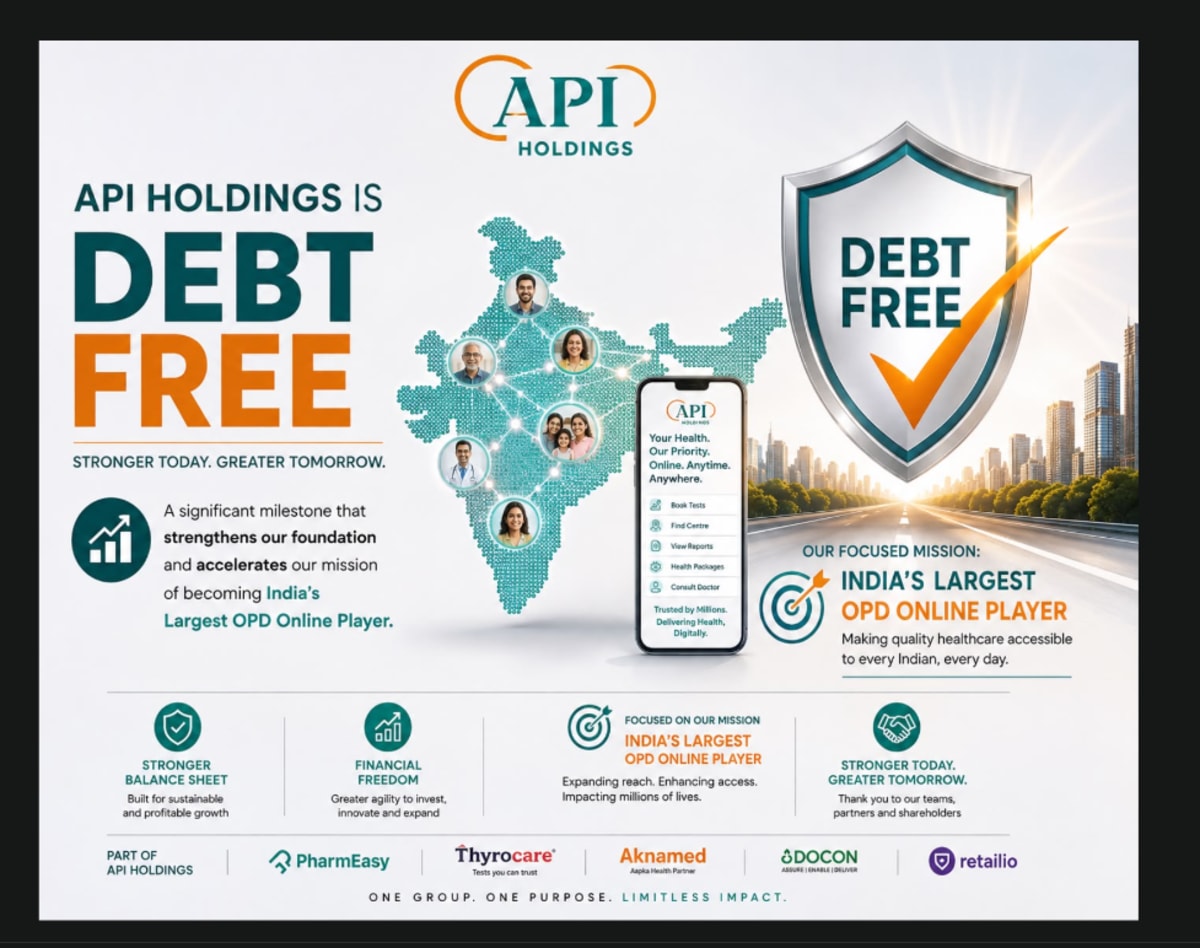
API Holdings, the parent company of PharmEasy and a major player in India's digital healthcare ecosystem, is undergoing a significant strategic transformation. After years of aggressive expansion and financial pressure, the company is now placing greater emphasis on profitability, debt reduction and sustainable growth.
The company's latest strategy is centered around building a stronger balance sheet while expanding its integrated healthcare platform. The goal is not simply to grow rapidly, but to create a financially sustainable business capable of serving consumers across medicines, diagnostics, consultations and other outpatient healthcare services.
The message highlighted in the accompanying graphic — “Debt Free” — represents the direction of the company's turnaround. However, the latest publicly reported figures indicate that API Holdings was still carrying debt, meaning the debt-free position should be viewed as a target rather than an already completed milestone. In May 2026, reports stated that API Holdings had reduced its debt from approximately ₹1,800 crore to around ₹1,050 crore and refinanced the remaining debt at a lower interest rate.
From High-Growth Expansion to Financial Discipline
API Holdings built its position through a combination of organic growth and acquisitions. Its ecosystem today includes well-known healthcare businesses such as PharmEasy, Thyrocare, Aknamed, Docon, Ascent Health and Retailio.
According to API Holdings, the company aims to operate an integrated digital healthcare ecosystem connecting consumers with pharmacies, pharmaceutical companies, doctors, hospitals, laboratories and other healthcare stakeholders.
The company expanded rapidly during the digital-health boom. PharmEasy became one of India's leading online pharmacy platforms, while API Holdings expanded into diagnostics, healthcare supply chains and technology-enabled hospital services.
However, rapid expansion also created significant financial pressure. The company had accumulated substantial debt, particularly following its acquisition of Thyrocare in 2021.
The current strategy is therefore markedly different: profitability before aggressive expansion.
Debt Reduction Becomes a Major Priority
When Rahul Guha took over as CEO of API Holdings in August 2025, the company was reported to have around ₹1,800 crore of debt, with borrowing costs above 20%.
By May 2026, the reported debt had been reduced to approximately ₹1,050 crore, with the remaining debt refinanced at roughly 11%.
This represents an important step in strengthening the company's financial position.
Management has indicated that API Holdings wants to achieve two important milestones before seriously considering a new IPO:
Become profitable, excluding Thyrocare Move toward a debt-free balance sheet
Only after achieving these objectives does the company intend to seriously evaluate a public-market listing.
PharmEasy at the Centre of the Strategy
PharmEasy remains one of the most recognizable brands within the API Holdings ecosystem.
Rather than competing only on discounts and rapid delivery, the company is increasingly focusing on healthcare services and higher-margin categories.
These include:
Online medicine delivery Generic medicines Private-label products Diagnostics Doctor consultations Physiotherapy Dietitian consultations Weight-management services Vaccination and healthcare services
According to management commentary reported in May 2026, PharmEasy reached monthly break-even in March, while the company has been working to increase the contribution of higher-margin services and products.
This shift is significant because online pharmacy businesses can face considerable pressure from discounts, logistics expenses, inventory requirements and competition.
Moving toward services and higher-margin healthcare categories could therefore help API Holdings improve profitability without depending entirely on increasing medicine-order volumes.
Thyrocare Provides an Important Growth Engine
One of the biggest strengths within the API Holdings ecosystem is its diagnostics business, Thyrocare Technologies.
Thyrocare is a listed diagnostics company and has become an important contributor to the group's overall financial performance.
For Q4 FY26, Thyrocare reported consolidated revenue of approximately ₹223.95 crore, up 20% year-on-year. EBITDA increased 31% to about ₹75.09 crore, while profit after tax rose 128% to approximately ₹48.7 crore.
This strong performance makes diagnostics an important part of API Holdings' broader healthcare strategy.
The contrast between the two businesses is notable: while API Holdings continues its debt-reduction and profitability journey, Thyrocare has been delivering strong operational and profit growth.
Building India's Integrated OPD Healthcare Platform
API Holdings' larger ambition extends beyond online pharmacy.
The company describes itself as an integrated digital healthcare platform that connects different participants across the healthcare value chain.
The ecosystem includes:
PharmEasy – Digital pharmacy and healthcare services
Thyrocare – Diagnostics and laboratory testing
Aknamed – Healthcare supply-chain and hospital procurement solutions
Docon – Technology solutions for doctors and clinics
Retailio – Digital pharmaceutical distribution and pharmacy connectivity
This interconnected model could allow API Holdings to participate in multiple stages of a patient's healthcare journey rather than relying on a single product category.
The company's stated mission is to simplify healthcare and impact lives through technology and an interconnected network.
Technology and AI Are Becoming Key Enablers
API Holdings is also increasing its use of artificial intelligence and technology.
In 2026, the company conducted its HackEasy Season 3 technology hackathon in collaboration with Amazon Web Services, bringing together more than 150 technology professionals across 35 teams.
The initiative focused on AI-powered solutions for healthcare, including voice-based order placement, WhatsApp ordering for chemists and AI-enabled supply-chain workflows.
These developments show how the company is attempting to use technology not only to acquire customers but also to reduce operational costs and improve the efficiency of its healthcare ecosystem.
For a business operating across medicine delivery, diagnostics and healthcare supply chains, automation could become an important tool for improving margins.
The IPO Question
API Holdings has previously explored the public-market route.
The company filed IPO papers in 2021 for a proposed ₹6,250 crore issue, but the plan was subsequently withdrawn in 2022 amid changing market conditions and weaker investor appetite for loss-making technology companies.
The company is now taking a more cautious approach.
Rather than rushing toward an IPO, management has indicated that profitability and debt reduction need to come first. This could represent a significant change from the earlier growth-at-all-costs approach.
A stronger balance sheet and sustainable profitability could make any future IPO story more credible to investors.
What the “Debt Free” Message Really Means
The “Debt Free” message shown in the graphic should therefore be understood carefully.
API Holdings' debt-reduction journey is real, but the company had not yet reached a completely debt-free position according to the latest reliable reports available.
The company had already made substantial progress by reducing reported debt from around ₹1,800 crore to approximately ₹1,050 crore. Management's stated objective was to continue reducing debt and ultimately reach a debt-free position, particularly for the business excluding Thyrocare.
That distinction is important for investors, readers and anyone sharing the graphic online.
Stronger Today, Greater Tomorrow
The transformation underway at API Holdings represents a broader shift taking place across India's digital-healthcare sector.
The first phase of the industry was driven largely by rapid customer acquisition, aggressive expansion and large-scale funding.
The next phase is likely to be defined by profitability, operational efficiency, stronger balance sheets and sustainable growth.
API Holdings is attempting to position itself for that next phase.
Its combination of PharmEasy's consumer healthcare platform, Thyrocare's diagnostics business and its broader B2B healthcare ecosystem gives the group multiple avenues for growth.
The immediate challenge, however, remains clear: the company needs to continue improving profitability and reducing debt.
If it successfully achieves those goals, API Holdings could enter its next chapter with a much stronger financial foundation.
Conclusion
API Holdings' journey from rapid expansion to financial discipline is becoming one of India's notable digital-healthcare turnaround stories.
The company's focus has shifted toward profitability, debt reduction, higher-margin healthcare services, technology adoption and sustainable growth.
While the company was not yet completely debt-free based on the latest reliable figures available, its substantial reduction in debt demonstrates progress toward that objective. Management's longer-term ambition is to build a profitable, low-debt healthcare platform that can potentially return to the IPO market when the business is ready.
For API Holdings, the next stage is no longer simply about becoming bigger. It is about becoming stronger, more efficient and financially sustainable.
The road to “Debt Free” is still underway — but the direction is clear.
Key Takeaways API Holdings is the parent company of PharmEasy and operates a broader digital healthcare ecosystem. The company has been focusing on profitability and debt reduction. Reported debt fell from approximately ₹1,800 crore to ₹1,050 crore by May 2026. Management has targeted a debt-free position as part of its turnaround strategy. PharmEasy is expanding its focus beyond medicines into higher-margin healthcare services. Thyrocare remains an important and financially strong part of the group. API Holdings is increasing its use of AI and technology across its operations. The company may revisit IPO ambitions after achieving stronger profitability and balance-sheet conditions. The “Debt Free” claim in the supplied graphic should currently be treated as a strategic goal rather than a verified completed milestone.
Related Investment Opportunities
Related Market Intelligence


Invest in the Source
Our analysts track these companies 24/7. Don't just read the news—own the upside.
View Live Listings