Jio IPO: Buy Unlisted Shares Now or Apply in the IPO?
ShareSaathi Intelligence
Head of Research

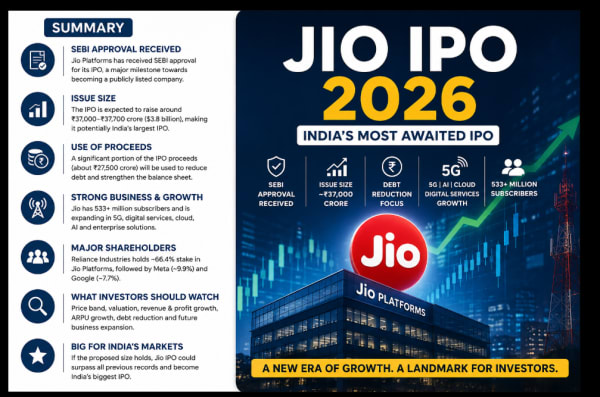
Jio Platforms is set to open India's largest-ever IPO on October 21, 2026, at about ₹11 trillion ($114 billion), according to Bloomberg. For pre-IPO investors the conclusion is blunt: the IPO itself is very likely the cheapest and safest way to own Jio.
Three facts drive that. Jio barely trades in the unlisted market, because its shares sit with Reliance and the 2020 investors. The few unlisted quotes reported, ₹1,250–1,275, are above the roughly ₹1,190 a share the reported valuation implies. And unlisted shares bought now are locked in for six months after the IPO, while shares allotted in the IPO can be sold on listing day.
Recent history points the same way. HDB Financial, Tata Capital and NSDL all priced their IPOs 36–71% below their peak unlisted prices, leaving late pre-IPO buyers with losses before trading began.
For the background on SEBI's approval and the issue structure, see our earlier explainer: Jio IPO 2026: SEBI Approval, Issue Size, Valuation and What Investors Should Know.
The deal
The issue is a pure fresh issue, with no offer for sale: no existing shareholder, Reliance, Meta and Google included, is selling. Price band and lot size will only appear in the red herring prospectus (RHP), days before the anchor book.
| Item | Detail |
|---|---|
| Structure | Book-built, fresh issue only, up to 27 crore shares |
| Face value | ₹10 per share |
| Expected size | About ₹33,000–37,000 crore (~$3.8 billion) |
| Price band | Not yet announced; market talk ranges from ₹1,100–1,300 to ₹1,350–1,450, all unconfirmed |
| Reported equity valuation | About ₹11 trillion ($114 billion) |
| Reported enterprise valuation | $143–146 billion (banking sources) |
| Anchor book | October 19, 2026 (reported) |
| Subscription window | October 21–23, 2026 (reported) |
| Listing | October 28, 2026 on NSE and BSE (reported; Bloomberg says before October 30) |
| Reserved portions | Employees and eligible Reliance Industries shareholders |
| Use of proceeds | Up to ₹27,500 crore to prepay Reliance Jio Infocomm borrowings; the rest (capped at 25%) for general corporate purposes |
| Lead managers | 19 banks, led by Kotak, Morgan Stanley, BofA, Goldman Sachs, J.P. Morgan, JM Financial and SBI Caps |
| Registrar | KFin Technologies |
Jio filed its draft prospectus on June 19, 2026, and SEBI issued its observation letter on August 28. All dates above come from bankers and press reports, not from the company, and can move with markets.
The numbers do not quite line up yet, which is worth noticing. FY26 earnings per share of ₹33.62 on ₹30,050 crore of profit imply about 894 crore shares today, or about 921 crore after the issue. At ₹11 trillion, that works out to roughly ₹1,190 a share. At that price, the 27 crore new shares would raise about ₹32,000 crore ($3.4 billion) for a free float of about 2.9%, just above SEBI's 2.5% minimum for issuers worth over ₹5 lakh crore. If the band comes in at the higher ₹1,350–1,450 being talked about, the valuation is higher than Bloomberg's figure.
Unlisted price vs IPO price
India's recent big IPOs have been priced well below what unlisted buyers paid, and Jio's reported unlisted quotes already sit above the price its valuation implies.
| Company | IPO | Peak unlisted price (₹) | IPO price (₹) | Gap |
|---|---|---|---|---|
| Tata Capital | Oct 2025 | 1,125 | 326 | −71% |
| HDB Financial Services | Jun 2025 | 1,500 | 740 | −51% |
| NSDL | Jul 2025 | 1,250 | 800 | −36% |
| Jio Platforms | Oct 2026 (estimate) | 1,275 | ~1,190 (implied, not announced) | −7% |
The pattern has a cause. Unlisted prices are set by a handful of brokers and retail buyers chasing a scarce stock, while the IPO price is set by institutions in a book-build. When the two meet, the institutions win. Tata Capital's comparison is also affected by a rights issue in July 2025, but HDB Financial and NSDL had no such excuse.
For Jio the gap is smaller, about 7%, because its unlisted quotes have stayed near ₹1,250–1,275 rather than spiking. The direction is the same.
Two cautions on the numbers:
- Jio barely trades unlisted. Its holders are Reliance (66.4%), Meta, Google and the 2020 funds. Jio does not meaningfully circulate in the retail unlisted market, so check any offer by ISIN before you pay.
- The grey-market premium is not a price. Investorgain showed a GMP of ₹154 on October 6 and IIFL reported ₹160, but both are quoted against a price band that has not been announced. Treat them as a mood reading, not a forecast.
Buy unlisted now, or apply in the IPO?
With two weeks to go, applying in the IPO beats buying unlisted on almost every count: the price is likely lower, you can sell on listing day, and the money moves through the exchange rather than a private deal.
| Buy unlisted now | Apply in the IPO | |
|---|---|---|
| Price | ₹1,250–1,275 reported, if a seller exists | Band not yet set; about ₹1,190 implied by a ₹11 trillion valuation |
| Availability | Very thin: holders are Reliance and the 2020 investors, not retail | 27 crore new shares; at least 35% of the net issue reserved for retail |
| Lock-in | 6 months after IPO allotment (about late April 2027 if allotment is October 26) | None: sell from listing day |
| Certainty of getting shares | Certain once the transfer completes | A lottery if oversubscribed, as an issue this size likely will be |
| Tax if sold after listing | Holding period runs from your purchase date: 20% if held 12 months or less, 12.5% above ₹1.25 lakh if longer | Same rules, from the allotment date |
| Tax if sold before listing | Unlisted rules: slab rate up to 24 months, 12.5% after, no ₹1.25 lakh exemption | Not applicable |
| How money moves | Off-market demat transfer through a broker or platform | UPI or ASBA: funds are blocked, debited only if you get an allotment |
| Main risk | Paying above the IPO price, then six months of market risk you cannot exit | Not getting an allotment |
The lock-in is the part unlisted buyers most often miss. SEBI's rules lock the entire pre-issue capital held by non-promoters for six months after the IPO. A buyer at ₹1,275 cannot sell on listing day even if the stock opens above that, and must ride out whatever happens through April 2027, including the day the lock-in expires and other pre-IPO holders can sell too.
One case still favours unlisted holders: someone who already holds shares bought well below the IPO price. For them the question is whether to sell before listing, at unlisted-market tax rates, or hold through the lock-in.
How to get shares in the IPO
The best odds go to investors who hold at least one Reliance Industries share in demat form on the record date: they can bid twice, once in the shareholder quota and once as retail.
| Category | Who | Share of issue | Bid limit |
|---|---|---|---|
| Retail | Resident individuals | At least 35% of the net issue | Up to ₹2 lakh |
| Reliance shareholder quota | Individuals holding RIL shares in demat on the record date (same PAN) | Up to 10% of the issue, about 2.7 crore shares; exact size in the RHP | Up to ₹2 lakh |
| Employees | Eligible Jio employees | Set in the RHP | Up to ₹5 lakh |
| Non-institutional (HNI) | Individuals and entities bidding above ₹2 lakh | At least 15% of the net issue | No upper limit |
| Qualified institutions | Funds, banks, insurers; includes the anchor book | Up to 50% of the net issue | No upper limit |
What to do, in order:
- Before the record date: if you want the shareholder quota, make sure at least one RIL share sits in your demat account under the PAN you will bid with. The record date is the RHP date, which has not been announced yet, so a share bought late may not count.
- When the RHP comes out: note the price band, lot size and the exact quota sizes.
- October 21–23 (reported): bid at the cut-off price through your broker app using UPI or ASBA. One bid per category per PAN; a second bid in the same category can get both rejected.
- Around October 26: check allotment on the KFin Technologies registrar site. Blocked funds are released if you get nothing.
- Listing day, around October 28: IPO shares carry no lock-in, so you choose whether to sell or hold.
The quota gives no free shares. Reliance shareholders get only a separate, usually less crowded queue to apply in, not an entitlement.
How we got here
Jio launched in September 2016 and became India's largest carrier. In 2020 Reliance sold 32.97% of Jio Platforms for ₹1.52 lakh crore ($20.5 billion) to Meta, Google and funds including KKR, Silver Lake and Saudi Arabia's PIF, valuing it at about $58 billion before the money came in. At the August 29, 2025 AGM, Mukesh Ambani promised a listing "by the first half of 2026"; that slipped to October.
None of the 2020 investors is selling in this IPO. Reliance switched to an all-fresh issue after disagreements over price, so their exits are deferred to later share sales, a supply overhang public holders should expect.
The business
Jio is a cash machine: FY26 (April 2025–March 2026) revenue was ₹1.47 lakh crore, with a 51.9% EBITDA margin and ₹30,049 crore of net profit. Growth is steady rather than explosive, about 14–15% a year, driven by tariff increases, 5G upgrades and home broadband.
| Fiscal year | Revenue (₹ crore) | Net profit (₹ crore) |
|---|---|---|
| FY26 (Apr 2025–Mar 2026) | 1,46,885 | 30,049 |
| FY25 (Apr 2024–Mar 2025) | 1,28,218 | 26,120 |
| FY24 (Apr 2023–Mar 2024) | 1,09,558 | 21,434 |
The latest quarter, Q1 FY27 (April–June 2026), kept the trend going:
- Subscribers: 533.3 million, up 8.9 million in the quarter; monthly churn 1.6%
- ARPU: ₹215.6 a month, up 3.3% from ₹208.8 a year earlier
- 5G: about 285 million users, and 5G now carries 1.5 times the traffic of 4G
- Home broadband: 28.6 million connections, over 14 million of them JioAirFiber (fixed wireless), which drove more than 75% of broadband additions
- Data: 43.7 GB per user per month; total traffic up 26.9% to 69.4 billion GB
- Profitability: operating revenue ₹39,173 crore (+11.8%), EBITDA ₹20,865 crore (+15.1%), a record 53.3% margin, net profit ₹7,764 crore (+9.2%)
The pitch to investors goes beyond telecom. The prospectus counts 6,817 patent applications and 11,303 employees in digital products, about 40% of staff. Reliance has also been positioning Jio as the platform for its AI and enterprise cloud ambitions. For now, though, mobile and broadband connectivity generate almost all the cash.
ARPU is the number to watch. At ₹216, Jio still earns about ₹48 a month less per user than Bharti Airtel (₹264), and each tariff round has historically triggered a burst of churn before subscribers recover.
Is $114 billion cheap?
By the standards of this deal's own history, yes: Bloomberg's figure is lower than every bank estimate published since the prospectus was filed, and close to what analysts thought Jio was worth two years ago.
| Estimate | When | Equity value (US$ billion) |
|---|---|---|
| 2020 funding round (pre-money) | 2020 | 58 |
| BofA | 2023 | 107 |
| Jefferies | Jul 2024 | 112 |
| JP Morgan (low end) | Jun 2026 | 136 |
| Jefferies | Jun 2026 | 180 |
| IPO target (Bloomberg) | Oct 2026 | 114 |
On earnings, ₹11 trillion is about 37 times FY26 net profit of ₹30,049 crore. Bharti Airtel, the only real listed peer, trades at about 42 times, while loss-making Vodafone Idea is not comparable. Adding Reliance Jio Infocomm's ₹27,579 crore of net debt gives an enterprise value of about 15 times FY26 EBITDA of ₹76,255 crore.
The Bloomberg number is also close to sum-of-parts work by brokers covering Reliance. Motilal Oswal values the telecom business alone at ₹11.3 lakh crore and all digital services at ₹12 lakh crore.
One figure needs care. Banking sources put Jio's enterprise value at $143–146 billion, about $30 billion above the equity figure. That gap is far larger than Jio's reported net debt, so it likely counts other liabilities such as deferred spectrum payments and leases, or assumes a higher price. The two figures should not be read as a contradiction.
The discount is deliberate. Reliance reportedly chose an all-fresh issue and conservative pricing so public buyers see gains after listing, even though its 2020 investors wanted a higher price.
A record, and a test for the market
Whatever the final price, Jio will almost certainly be India's largest IPO, and only the second over ₹25,000 crore.
| IPO | Year | Issue size (₹ crore) |
|---|---|---|
| Jio Platforms (expected) | 2026 | 32,000–37,800 |
| Hyundai Motor India | 2024 | 27,859 |
| LIC | 2022 | 20,557 |
| Paytm | 2021 | 18,300 |
| Tata Capital | 2025 | 15,512 |
| Coal India | 2010 | 15,199 |
| HDB Financial Services | 2025 | 12,500 |
The deal was made possible by a rule change. In March 2026 the government relaxed free-float rules for very large issuers: a company worth over ₹5 lakh crore now needs a minimum public offer of ₹15,000 crore and at least 1% of its market value, with dilution of at least 2.5%. Before, the floor was 5%, which at Jio's size would have meant selling over ₹50,000 crore of stock at once.
The rule was written with issuers like Jio, Flipkart and NSE in mind, which plans its own listing of about ₹30,000 crore. India's market will have to absorb several mega-issues in quick succession, and Jio sets the tone.
Demand looks broad. Bloomberg reports Jio has finished gauging demand and is moving to price discussions with investors. A quota for Reliance's own shareholders lets the group tap one of India's largest retail investor bases, and Hyundai's 2024 listing showed how a giant issue can be well subscribed overall yet still list below its offer price.
Risks and open questions
The biggest question is not whether Jio is a good business but whether a tiny float, a controlling parent and a valuation already trimmed once leave much on the table for public buyers.
- A thin float. Roughly 3% of the company will trade. Reliance keeps control, and SEBI's new rules give Jio five years to reach 15% public shareholding and ten to reach 25%. Expect years of follow-on supply from Reliance, Meta, Google and the 2020 funds.
- Holding-company discount at Reliance. Nuvama warns that "Reliance Industries shareholder gains may be limited by holding company discount" once Jio is directly investable. Antique Stock Broking calls the IPO a positive milestone that "as structured, could impose a holdco discount" versus a cleaner demerger.
- Insiders who chose not to sell. Reliance moved from an offer for sale to an all-fresh issue after pricing disagreements with existing investors, according to Outlook Business. None of the 2020 investors is exiting at this price.
- Debt and spectrum. Reliance Jio Infocomm had ₹70,781 crore of borrowings and ₹27,579 crore of net debt at March 31, 2026; the IPO repays up to ₹27,500 crore. Future spectrum auctions and licence renewals are listed as key risks.
- Tariffs and competition. Growth leans on price rises in a market with two strong players, and every tariff round has cost Jio subscribers before they came back.
- Tax and legal claims. Subsidiaries face 200 tax proceedings involving ₹10,811 crore across judicial forums.
- New-technology bets. The prospectus flags obsolescence risk and heavy reinvestment needs around satellite broadband and AI.
Checklist before you invest
For most unlisted-share investors the right move is to skip unlisted Jio and prepare to bid in the IPO. Work through this list over the next two weeks.
- Hold off on unlisted Jio. If someone offers it, ask for the ISIN and the seller's demat details, check them against the prospectus, and compare the price with the IPO band before paying.
- Buy one RIL share now if you want the shareholder quota, so it sits in your demat before the RHP date.
- Read the price band and lot size in the RHP. With about 921 crore shares after the issue, each ₹100 on the band moves the valuation by about ₹92,000 crore.
- Watch the anchor book on October 19 (reported). Long-only global funds and Indian mutual funds signal staying power; a book heavy with hedge funds signals a listing-day trade.
- Bid on October 21–23 (reported) at the cut-off price, once in retail and once in the shareholder quota if eligible.
- Already hold unlisted Jio? Note your purchase date and price. You are locked in until about late April 2027, and lock-in expiry days often bring selling pressure.
- Watch Reliance's own share price. If it falls as Jio rises, the holding-company discount is arriving, which matters if you hold RIL for the quota.
This article relies on press reports and banker briefings ahead of the final prospectus; dates, size and valuation may change. It is not investment advice.
Sources
- Bloomberg: Ambani's Jio said to seek about $114 billion valuation in IPO
- Times of India: Jio plans to launch IPO on October 21
- HDFC Sky: Jio Platforms IPO date and listing
- Groww: Jio Platforms receives SEBI approval
- Outlook Money: Jio IPO issue size, debt, valuation, financials
- Multibagg: Jio Platforms DRHP details
- IIFL: Jio IPO GMP and issue size
- Investorgain: Jio Platforms IPO GMP
- Flattrade: Jio Platforms IPO 2026 guide
- IPO Ji: Jio IPO shareholder quota
- buyunlistedshares.com: Jio IPO and the holding-company discount
- JM Financial: What happens to unlisted shares after an IPO
- Groww: Taxation of unlisted shares
- iPleaders: SEBI ICDR amendments 2026
- 5paisa: Free-float rule change for mega IPOs
- Outlook Business: HDB Financial unlisted vs IPO price
- IANS: Tata Capital IPO and unlisted investors
- Business Today: NSDL unlisted price before IPO
- Outlook Money: India's 10 largest IPOs
- TelecomTalk: Jio Q1 FY27 subscribers and ARPU
- IndMoney: Airtel vs Jio, Q1 FY27
- TechCrunch: Jefferies' 2024 Jio valuation
- Investing.com: Jio DRHP and $136–180 billion valuations
- Business Today: Nuvama on Reliance shareholders
- Outlook Business: Jio switches to an all-fresh issue
- Storyboard18: Ambani on the Jio listing
- Wikipedia: Jio Platforms
Related Market Intelligence
Invest in the Source
Our analysts track these companies 24/7. Don't just read the news—own the upside.
View Live Listings