Goodluck India Jumps 13% on Defence Merger: What It Means for Goodluck Defence Unlisted Shares
ShareSaathi Intelligence
Head of Research
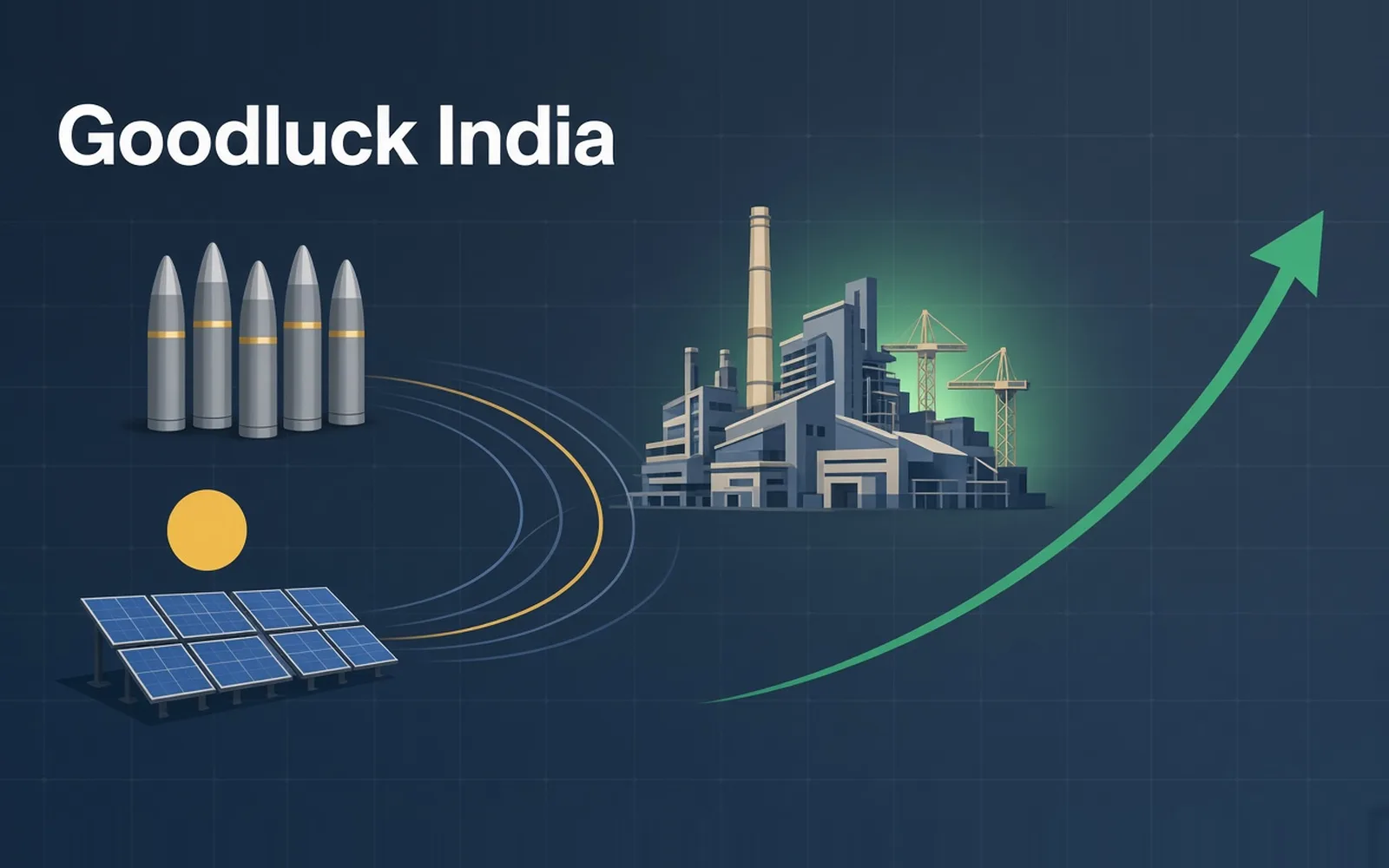
Goodluck India's board has decided to fold its defence arm into the listed company. The stock rallied 13% on the news. If you own, or are thinking of buying, Goodluck Defence and Aerospace unlisted shares, the number that now matters most is one nobody has seen yet: the swap ratio.
On Monday, October 12, 2026, Goodluck India shares closed at about ₹568, up 13.4% from Friday's ₹500.80, after touching a new 52-week high of about ₹580 during the session. The Sensex fell 0.8% the same day, so this was a company-specific move, not a market one.
The trigger was a board decision taken the same day. Goodluck India approved a scheme of amalgamation to merge two group companies into itself: Goodluck Defence and Aerospace Limited, its artillery-shell maker, and Goodluck Green Energy Limited. This article explains what was decided, why the market liked it, and what it means for anyone holding the defence arm's unlisted shares.
The decision at a glance
| Item | Detail |
|---|---|
| Listed parent | Goodluck India Limited (NSE: GOODLUCK, BSE: 530655) |
| Companies merging in | Goodluck Defence and Aerospace Ltd; Goodluck Green Energy Ltd |
| Board approval | October 12, 2026 |
| Earlier step | July 11, 2026: in-principle approval to merge Green Energy only |
| Swap ratio | Not yet announced; valuers are working on it |
| Approvals still needed | Stock exchanges and SEBI, shareholders and creditors, and the NCLT |
| Goodluck India close (Oct 12) | About ₹568, up 13.4% |
| Goodluck Defence unlisted ask (ShareSaathi) | ₹412 |
Who Goodluck India is
Goodluck India was founded in 1986 by Mahesh Chandra Garg as Goodluck Steel Tubes, and took its current name in 2016. It is based in Ghaziabad, with its main plants in Sikandrabad in Uttar Pradesh and a precision-tube plant in Kutch, Gujarat. It makes engineering steel products, much of it for export:
- ERW pipes and cold-rolled sheets
- Precision and automotive tubes, including hydraulic tubes
- Transmission towers and infrastructure structures
- Solar module mounting structures, where it says it has more than 30% market share
- Heavy forgings for energy and engineering customers
It is a steady, growing business, but most of it earns thin margins. On the company's own figures, pipes and sheets earn 3% to 5% EBITDA margins, and the better segments earn 10% to 13%.
| Year (consolidated) | Revenue (₹ crore) | Net profit (₹ crore) |
|---|---|---|
| FY2023 | 3,072 | 88 |
| FY2024 | 3,525 | 132 |
| FY2025 | 3,936 | 166 |
| FY2026 | 4,100 | 183 |
Net profit has roughly doubled in three years. Borrowings rose to ₹1,119 crore at March 2026 from ₹882 crore a year earlier, mostly to fund expansion. The promoter group held 54.0% of the company in August 2026.
Defence: the part the market is paying for
In 2023, Goodluck India set up Goodluck Defence and Aerospace to make artillery shell bodies, mainly the 155 mm shell used by the Army's howitzers. Its plant at Sikandrabad started commercial production in October 2025 with a capacity of about 1.5 lakh shells a year.
Since then, the defence arm has moved quickly:
- March 2026: began shipping its first export order, worth about $6 million.
- May 2026: won a ₹52.2 crore domestic order for 155 mm shells.
- June 2026: won a ₹255 crore domestic order for 155 mm long-range shells in ready-to-fill condition, to be delivered within 10 months. Management said on its results call that this covers about 50,000 shells.
- Q1 FY2027 (April to June 2026): defence revenue of about ₹84 crore at an EBITDA margin of about 38%. That compares with about ₹46 crore of defence revenue in the whole of FY2026.
- FY2027 guidance: ₹300 to ₹350 crore of defence revenue at 30% to 35% EBITDA margins.
That margin is the point. The core steel business earns single-digit to low-teens margins. Defence earns three times as much. As defence grows, it changes what kind of company Goodluck India is.
The arm is expanding capacity to about 4 lakh shells a year. To fund this, it raised ₹276 crore in September 2026 by issuing 73.6 lakh new shares at ₹375 each to outside investors, and Goodluck India approved a corporate guarantee of up to ₹275 crore for a project loan from HDFC Bank. Management said in August that the expansion had slipped by six to nine months, with construction expected to start by the January–March 2027 quarter and commercial production by the same quarter of 2028.
Q1 FY2027 in numbers
| ₹ crore | Q1 FY2027 | Q1 FY2026 | Change |
|---|---|---|---|
| Consolidated revenue | 1,287 | 983 | +31% |
| Consolidated EBITDA | 139.7 | 95.8 | +46% |
| Consolidated net profit | 67.2 | 40.1 | +67% |
| Standalone EBITDA (parent only) | 110.5 | 95.8 | +15% |
The gap between the consolidated and standalone EBITDA, about ₹29 crore in a single quarter, comes mostly from the defence arm. In other words, most of the growth this year is happening outside the listed company's own books. That is why the merger matters.
Why the stock jumped
1. The defence profits come home in full. Today Goodluck India owns only part of the defence arm. After the merger it will own the whole business directly, so all of the defence profit will belong to Goodluck India shareholders, with no minority interest carved out.
2. It replaces a listing plan shareholders disliked. On the August results call, management discussed listing the defence arm separately, at a pre-money valuation of about ₹1,850 crore, so it could raise money without using the parent's balance sheet. Some Goodluck India shareholders objected that this would dilute their claim on the best part of the group. Merging the arm into the parent removes that risk. The company has not commented separately on the earlier IPO idea.
3. No holding-company discount. Investors usually value a listed parent at less than the sum of its stakes in subsidiaries. Holding the business directly removes that discount.
4. Momentum was already there. Including Monday, the stock is up about 55% in 2026, helped by the strong June-quarter results, the defence orders and the bonus issue.
One caution: the swap ratio has not been announced. The market is pricing the structure of the deal, not its terms. The terms decide how much of Goodluck India the defence arm's other shareholders will receive, and so how much dilution existing Goodluck India holders take.
"Wholly-owned"? Not quite
Much of today's coverage calls both companies wholly-owned subsidiaries. For Goodluck Defence and Aerospace, that is not correct, and it is the most important detail for our readers.
- Goodluck Defence raised ₹136.5 crore from outside investors at ₹150 a share in December 2023. That is why its shares trade in the unlisted market at all.
- Goodluck India held 79.43% at the end of FY2025.
- The September 2026 placement added 73.6 lakh shares for outside investors, taking the total to about 5.65 crore shares. On our estimate, that leaves Goodluck India with roughly 69% and outside shareholders with roughly 31%.
Because outside shareholders hold about 31%, the merger is not just an internal tidy-up. Those shareholders must receive Goodluck India shares in exchange for theirs, and the ratio has to be set by an independent registered valuer.
Goodluck Green Energy is less clear. It was incorporated in January 2024 and converted to a public company in May 2025. FY2025 records summarised by research platforms describe it as held by promoter-family members and promoter-group entities, with no revenue that year. If that is still the shareholding, the merger would issue Goodluck India shares to the promoter family. That makes its valuation a related-party question that minority shareholders should read closely when the scheme is filed.
What this means if you hold Goodluck Defence unlisted shares
When the merger takes effect, your Goodluck Defence shares will be cancelled and you will receive listed Goodluck India shares in their place. Two numbers decide what you end up with: the swap ratio, and Goodluck India's share price at the time.
What the market is implying. At ShareSaathi's ₹412 ask, Goodluck Defence is valued at about ₹2,330 crore. At the September placement price of ₹375, it was valued at about ₹2,120 crore.
Illustrative swap ratios. The table assumes Goodluck India at today's ₹568. These are our own illustrations, not company figures.
| If valuers price Goodluck Defence at | Goodluck India shares per 100 Goodluck Defence shares |
|---|---|
| ₹350 | about 62 |
| ₹375 (last placement price) | about 66 |
| ₹412 (today's unlisted ask) | about 73 |
| ₹450 | about 79 |
Put simply, a buyer at ₹412 today breaks even only if the final ratio gives about 73 Goodluck India shares for every 100 Goodluck Defence shares, at today's Goodluck India price. If the valuer anchors on the recent ₹375 placement, the ratio would be nearer 66, worth about ₹375 a share at today's price.
After the ratio is fixed, your value moves with Goodluck India's price. At a ratio of 66 per 100, every ₹50 move in Goodluck India changes the value of one Goodluck Defence share by about ₹33.
What you gain: a listed, liquid share in place of an illiquid unlisted one, and exposure to the whole Goodluck group rather than defence alone. What you give up: a pure defence holding and any chance of a separate defence IPO at a higher valuation.
On tax: under Indian tax law, receiving shares of the merged company in a qualifying amalgamation is generally not treated as a sale. Your original cost and holding period usually carry over to the new shares. Confirm your own case with a tax adviser.
What you need to do now: nothing. Keep the shares in your demat account. If the scheme is approved, the new Goodluck India shares are credited automatically after the record date, and the scheme document will say whether any lock-in applies.
What it means for Goodluck India shareholders
You get 100% of the fastest-growing, highest-margin business in the group instead of about 69%. You pay for it with new shares issued to the defence arm's outside holders.
As a rough guide, if the defence arm's roughly 31% minority is valued at around the ₹375 placement price, Goodluck India would issue about 1.15 crore new shares at today's price. That is on the order of 11% of its current share count. Whether this is a good deal depends on the ratio. A ratio that values defence at a high multiple helps the subsidiary's holders. A conservative one helps the parent's holders.
At about ₹568, Goodluck India is valued at roughly ₹5,700 crore, about 28 times trailing earnings. On our estimate, its current ~69% of the defence arm is worth ₹1,450 to ₹1,600 crore at the placement and unlisted prices. That is more than a quarter of the parent's market value, for a business that was only about 1% of revenue in FY2026.
A note on the bonus issue
Goodluck India issued two bonus shares for every share held, with a record date of August 21, 2026. The pre-bonus price of about ₹1,440 became about ₹480 to ₹495 after adjustment. Some charts and apps still show this as a 65% crash; it was not one. When you compare prices before and after August 2026, divide the older prices by three.
Timeline: what happens next
- Scheme filing. The draft scheme, valuation report and swap ratio are filed with BSE and NSE. This is the first time you will see the actual terms.
- Exchange and SEBI review. The exchanges issue observation letters on the scheme.
- NCLT process. The tribunal orders shareholder and creditor meetings, and the scheme is put to a vote.
- NCLT sanction. The tribunal approves the scheme, and it takes effect once filed with the Registrar of Companies.
- Record date and allotment. Goodluck India fixes a record date and allots new shares to Goodluck Defence and Green Energy shareholders. The new shares are then listed.
In India, schemes like this often take 9 to 15 months from filing to allotment, and sometimes longer.
The risks, plainly
- The swap ratio is unknown. A buyer paying today's unlisted ask is betting that the ratio will be at least as generous as the current price implies.
- Execution risk. The capacity expansion has already slipped by six to nine months, and the defence orders depend on inspection and acceptance by the end user.
- Customer concentration. Most defence revenue comes from a few government buyers, and exports need government clearances.
- Group leverage. Borrowings rose to ₹1,119 crore in FY2026, with a further ₹275 crore guarantee for the defence project loan.
- Related-party terms. If Goodluck Green Energy is promoter-held, its valuation in the scheme deserves close scrutiny.
- Approval delays. Any objection from the exchanges, SEBI or the NCLT can push the timeline out or change the terms.
- The core business. Steel-linked segments are exposed to steel prices, freight costs and export demand, which the company flagged as pressures in the June quarter.
How to buy or sell Goodluck Defence unlisted shares
The live price, lot size and company details are on the Goodluck Defence and Aerospace share page.
- Request a quote. WhatsApp ShareSaathi or use the form on the share page. You don't need an account to ask.
- Confirm the lot. The current lot is 500 shares, so the minimum ticket at ₹412 is about ₹2.06 lakh.
- Pay and complete KYC. Pay only to ShareSaathi's official bank account, never to an individual. Keep your UTR number and a screenshot of the payment.
- Receive the shares. They are credited off-market to your NSDL or CDSL demat account against ISIN INE0S7401019.
Already a holder and thinking of selling before the swap ratio is known? Ask our desk for a bid. You can compare other defence names on the unlisted share price list.
The bottom line
Goodluck India's rally is a vote for simplicity. Its best business, defence, is moving inside the listed company in full instead of being split off in a separate listing. For Goodluck India holders, that is good news, as long as the swap ratio is fair.
For Goodluck Defence's unlisted holders, the merger is a clear route to a listed share, but the price of that route is not yet known. Until the scheme and valuation report are filed, anyone buying at today's ₹412 is betting on a ratio of at least about 73 Goodluck India shares for every 100 Goodluck Defence shares. Wait for the filing if you want certainty. Buy before it only if you are comfortable with that bet.
Disclaimer: This article is for information and education only and is not investment advice. Unlisted shares are illiquid, prices are indicative dealer quotes, and the terms and timing of the merger are not yet known. The swap-ratio scenarios, the post-placement shareholding and the dilution estimate are ShareSaathi's own illustrations, not company figures. Data as of October 12, 2026. Please consult a SEBI-registered investment adviser before investing.
Related Investment Opportunities

Related Market Intelligence


Invest in the Source
Our analysts track these companies 24/7. Don't just read the news—own the upside.
View Live Listings